





by Folker, Pittsburgh HHH
What follows is just one man's impression gained over several years of hashing. Experienced trail-layers may want to ignore much of the advice contained herein, but novices are advised to pay close attention.
First, some axioms:
Axiom number 1 is the key to a successful hash run. KEEP CONTROL OF THE PACK! As long as the pack is where you want it to be, you can play them like puppets on a string, and they'll come back for more. But if they're scattered or off course, all your efforts will be in vain.
And the biggest element of keeping control is making clear marks. Once hounds get the idea that a trail is poorly marked, they will go for miles in directions you really didn't want them to go. When the pack is on flour, it should be obvious to everyone. Make your marks clearly visible. On a city hash, there should be two or three marks per block. On a clear footpath, every 25 yards should do it. When the path gets less obvious, like onto grass or woods, you need to put the marks closer together.
At a checkpoint, consider which ways the hounds are likely to check first. Try to choose the obvious directions for your falses, the unlikely ones for the true trail. How far should the first mark be from a check? That is a matter of controversy. I like to keep them within 100 yards of (and within sight of) the check. Any longer than that, and the pack is likely to go off in unexpected directions. In any case, establish a pattern at the beginning of the trail, and the hounds will instinctively operate within that pattern.
Falses need to be especially clear. Make your "F" in the middle of the trail, where the hounds can't help stepping on it. If you hide it off to the side, they'll overrun it and you'll lose control of the pack.
Anticipate where the pack will need to be brought together. Put your toughest checks and your longest falses where you can expect the pack to be most strung out. Steep ascents and descents, obstacles that require climbing over or under, and long straightaways generally separate the fast runners from the slow ones. Use plenty of falses: some of them may never be discovered. And remember that the surest way to bring the pack together is with a beer check.
The worst place for a tough check is right at the start. The pack is together already. The plodders will end up standing around while the aggressive checkers go off in different directions. Let the run build up some momentum before you start getting mean. And don't try anything tricky near the end of the run, either. Once hounds smell beer, they'll ignore all your marks and head straight in.
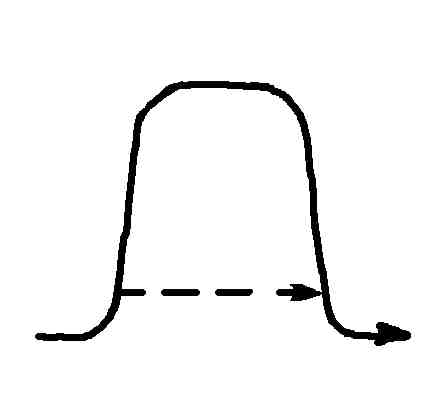
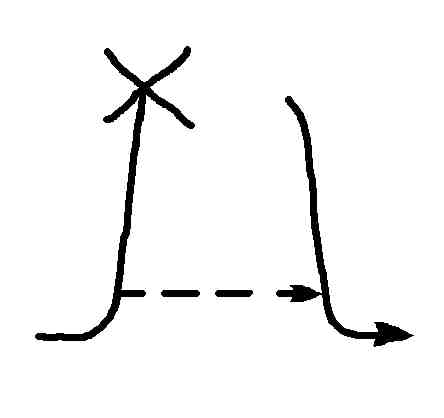
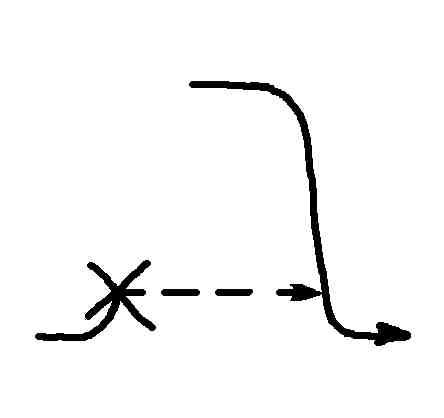
Shortcutting can be good or bad, depending on who's doing it. If the FRBs short cut, they can lead the whole pack astray. But if the plodders can short cut a nasty loop, you can bring the pack together.
The best way to keep the front of the pack from shortcutting is to not give them any opportunities. NEVER loop an outgoing trail segment near an incoming one: if they're within a quarter mile of each other someone is likely to get off on the wrong trail. And once they hit that other trail, it's anyone's guess whether they'll follow it in the forward direction or the reverse.
You CAN set up short cuts for the plodders, but ONLY where the trail is well marked. When the trail is well marked the FRBs will become complacent, and will go anywhere you lead them. The plodders will short cut when they see the opportunity. With unclear marking, the front of the pack will spread out sideways, and the short cut will be discovered by the wrong hounds!
 |
 |
 |
| always works | sometimes works | never works |
In planning a hash trail, start several weeks early. Schedule a couple of exploratory runs just to get the lay of the land and search out unusual terrain. Then put together a first-cut course and run it, thinking about where the checks and falses should go. Then run it backwards, which will give you an entirely different perspective on things. When you actually lay the trail, you should be thoroughly familiar with the territory, and all the alternatives routes. When you're done, the trail should be an organic whole, not just a bunch of checks and falses linked up haphazardly.
A good map is indispensable in planning a hash. The best maps are the USGS topographic maps, but a city street map will do. The maps are useful in suggesting areas for exploration in your preliminary planning. When you get into more detailed planning, you can make several photocopies of the map and draw alternative courses in. You can scale distances off the map to figure the length of the trail. Use the map to check for unexpected short cut opportunities. Before you lay the actual trail, plot the entire route, with all the checks and falses.
The ideal length of a hash is an hour to an hour and a quarter. Most first-time hares shoot for this length, then are surprised when the run takes twice that long! If your trail has long stretches of road running with few checks, you might be able to make the trail up to five miles long, but most of the time four miles are sufficient. Another way to judge the time a trail takes is to cover it from start to finish at a brisk walk or very slow jog. I've very seldom been on a hash that's too short, but many have been too long, so be conservative.
There is no such thing as a perfect trail. There are too many possible things to go wrong. Even if you do set up a run where everyone enjoys himself, no self-respecting hound will ever let a compliment pass his lips. However, if you follow these simple rules, you CAN avoid taunts like, "The hare eats shit," and even get people to eagerly anticipate your next turn as hare.